



Canada is still among the best places for immigrants looking for better job possibilities, excellent education, healthcare, and a high standard of living. Thousands of qualified professionals, students, and families continue to submit applications for Canadian Permanent Residence (PR) in 2026 by means of several immigration schemes.
Permanent residency is the legal right of immigrants to live, work, and study wherever in Canada. Including healthcare insurance and social support, PR holders also get several advantages akin to those of Canadian citizens.
Including qualifying standards, immigration routes, and application procedures, this comprehensive reference shows you how to apply for permanent residency in Canada in 2026.
What Is Canadian Permanent Residence?
A Canadian Permanent Resident is a person who has received permission to permanently reside in Canada but has not yet attained citizenship.

PR owners are permitted to:
- Work lawfully in Canada.
- Get public medical services.
- Study in Canadian universities
- Sponsor qualified family members
- Late,r submit an application for Canadian citizenship
Permanent residents are not permitted to vote in federal elections nor to occupy specific government roles.
Primary Immigration Streams for Canada PR in 2026
Canada has a number of immigration schemes for overseas candidates.
Express Entry
The most often used route for skilled laborers is managed by Immigration, Refugees, and Citizenship Canada (IRCC).
Express Entry includes:
- Federal Programme for Skilled Workers
- Federal Programme for Skilled Trades
- Canadian Experience Class
Under the Comprehensive Ranking System (CRS), candidates get points.
Points are given depending on:
- Age
- Instruction
- employment history
- Linguistic abilities
- Adaptability
Higher CRS candidates get invitations to apply (ITA) for permanent residency.
Provincial Nominee Programme (PNP)
Canadian provinces choose immigrants depending on local labor market requirements.
Among the well-known regions are:
- Ontario
- British Columbia
- Alberta
- Saskatchewan
- Manitoba
A provincial nomination raises CRS scores greatly and improves PR possibilities.
Sponsorship for Family
Eligible relatives can be sponsored by Canadian citizens and permanent residents.
This comprises:
- Spouses
- Children
- Parents and grandparents
Family sponsorship remains a vital immigration path in 2026.
Research to PR Route
Many overseas students initially research in Canada before seeking permanent residence.
Usually, this way entails:
- Learning in a Canadian university
- Getting a work permit after graduation
- Obtaining Canadian work experience
- Express Entry or PNP applications
International students are progressively flocking to this road.
Requirements for Canada PR eligibility
While each program has different needs, typical qualifying requirements include:
Educational Background
Usually, candidates require:
Minimum of secondary schooling
Higher education leading to improved CRS ratings
Often, educational records need an Educational Credential Assessment (ECA).
Requirements for Language Test
Applicants have to show that they can speak English or French by taking tests like:
- IELTS
- CELPIP
- TEF Canada
Higher language scores greatly increase immigration possibilities.
Work History
Most programs demand qualified employment experience in qualifying fields.
Work experience should:
- Get compensated
- Reach necessary skill levels
- Official job categorizations match
- Documentation of Financial Capability
Applicants could have to provide financial documentation demonstrating their capacity to sustain themselves and their family following their arrival in Canada.
Detailed Procedure to Request Canada PR in 2026
Step 1: Determine Eligibility
Find out which immigration scheme fits your qualifications and experience the best.
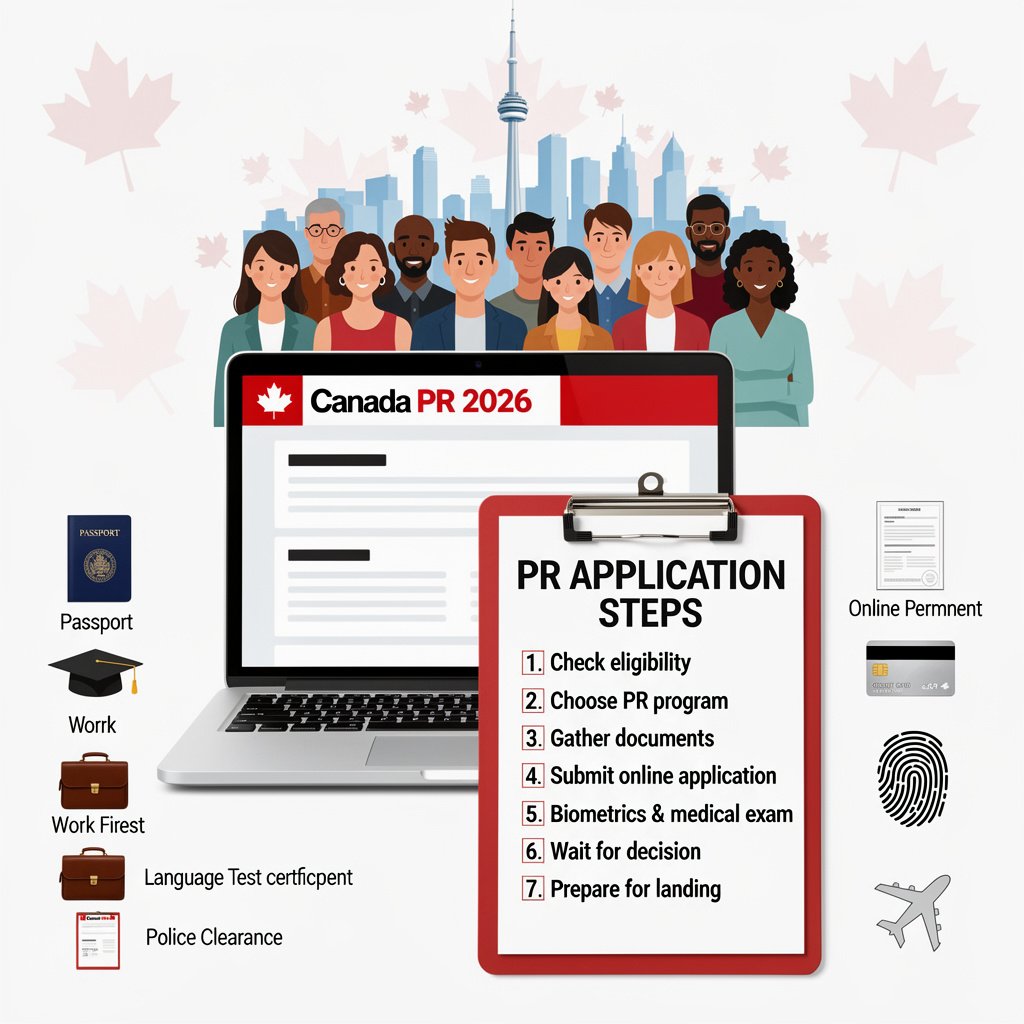
Step 2: Get Language Exam
- Take an authorized language test like IELTS or CELPIP.
- Strong language scores raise CRS ratings.
Step 3: Obtain an Educational Credential Assessment (ECA)
Usually, approved companies evaluate foreign educational records.
Step 4: Express Entry Profile
Applicants make an internet profile using the official Canadian immigration system.
The profile consists of:
- Personal data
- Learning
- Work History
- Language examination outcome
Step 5: Obtain CRS Rating
- Your CRS score is determined by the system using profile data.
- Higher scores increase your chances of getting an invitation.
Step 6: Get an Invitation to Apply (ITA)
Chosen candidates get an Invitation to apply for permanent residency.
Step 7: Send in your PR Application.
Applicants submit all necessary paperwork, including:
- Passport
- Police Records
- Medical examination
- Proof of employment history
- Financial records
Step 8: Background Checks and Biometrics
Applicants undergo security screening and biometrics.
Step 9: Get Approval for Public Relations
- Those who are accepted receive Confirmation of Permanent Residence (COPR).
- Only then can they lawfully relocate to Canada as permanent residents.
Advantages of Canadian Permanent Residence
Permanent residency has several long-term benefits.
- Improved employment prospects
- Healthcare Access
- Public education for children is free of charge
- Road to citizenship
- Stringent legal safeguards
Canada’s multicultural atmosphere and strong economy keep drawing immigrants from all over the world.
Common mistakes include:
- Inaccurate records
- Language tests that have expired
- Applications not completed
- Inaccurate information
- Not meeting deadlines
Before submitting, applicants should thoroughly go over all criteria.
Canadian Immigration Patterns in 2026
Canada keeps raising immigration goals to deal with labor shortages and spur economic expansion.
Priority vocations for 2026 might include:
- Medical practitioners
- IT experts
- Engineers
- Employees in the skilled trades
- Building professionals
Additionally, growing provincial initiatives are being implemented to draw in more qualified immigrants.
Conculsion
Applying for permanent residency in Canada in 2026 can lead to more job possibilities, higher-quality education, and long-term stability. There are many different immigration routes open, so skilled laborers, students, and families have good chances to create a life in Canada.
Applicants can increase their chances of successfully getting Canadian permanent residency by knowing the application process, satisfying eligibility criteria, and having the right paperwork ready.