

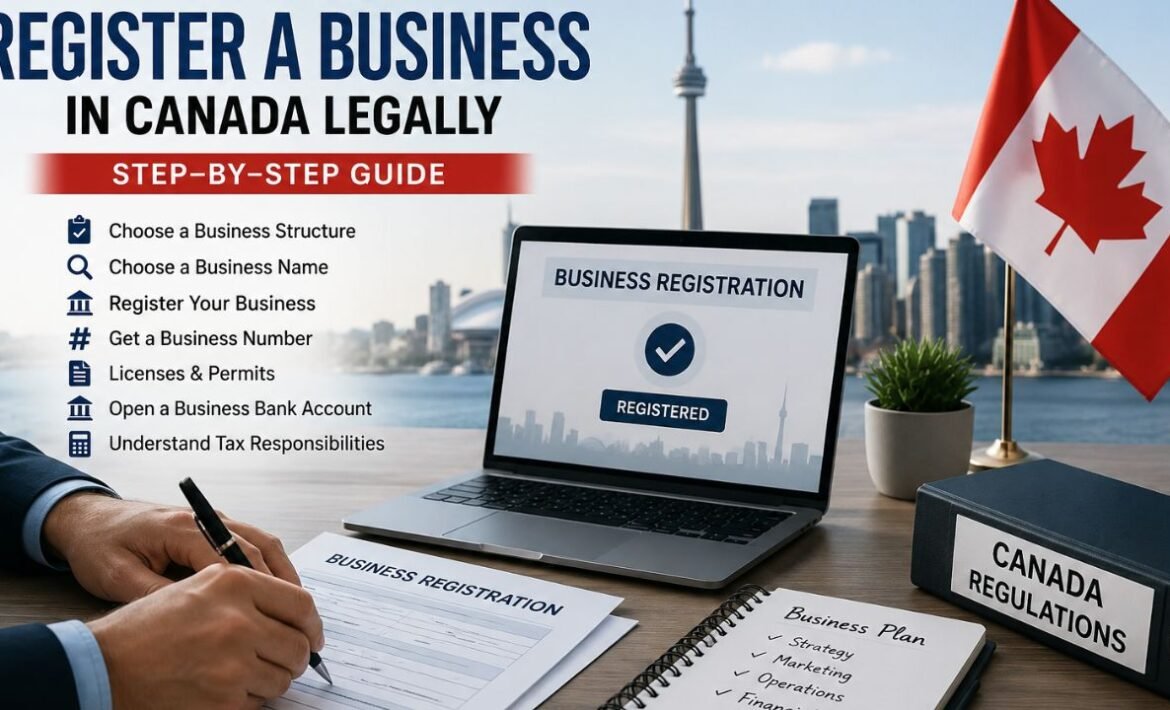

For business owners and investors, beginning a company in Canada provides a fantastic opportunity. Canada provides a business-friendly environment, clear rules, and a solid economy. Still, every company has to be legally registered prior to operations. Knowing the registration process will enable you to prevent legal problems and lay a solid basis for success.
Select a Business Framework
Choosing the appropriate corporate framework is the first phase. In Canada, the most frequent varieties are:
- Sole Proprietorship: Owned by one person and simple to establish.
- Partnership: Two or more individuals share ownership and accountability.
- Corporation: A distinct legal entity that provides tax advantages and liability protection.
Usually starting as sole proprietorships, small enterprises may choose incorporation for larger enterprises.

Choose a Name for Your Business
It’s crucial to pick a distinctive corporate name. Your name ought to be simple to recall and represent your offerings. Many times, you could require a NUANS name search to verify that another business isn’t already utilizing the same name.
While some companies run under the legal name of the proprietor, others register a distinct business name for branding objectives.
Register the Company
Once you have chosen the framework and name, you have to register your company with the proper government organization. Companies could register either:
- Provincially, for activities inside one province
- Federally for national protection and operation
Most provinces let you register online, which speeds up and simplifies the process.
Obtain a Business Number
Usually, the Canada Revenue Agency (CRA) issues Business Numbers (BN) to companies following registration. This number serves taxes and government records.
You could also need further accounts for:
- HST/GST taxes
- Payroll deductions
- Importing and exporting operations
Businesses with revenue exceeding the necessary income threshold should register for GST/HST collection.
Apply for Licenses and Permits
Before beginning business, some sectors need specific licenses or permits. The kind of company and the criteria determine the criteria.
Among these are:
- Food Business Licenses
- Construction permits
- Health and safety certification
- Professional accreditation
It is equally critical to review local government ordinances.
Open a Business Bank Account
Having a different corporate bank account helps one to handle money professionally. It enhances corporate credibility as well as simplifies tax filing.
Most banks need:
- Paperwork for Business Registration
- Identification
- Business Number
Know Your Tax Responsibilities
Every legal company in Canada has to abide by tax legislation. Businesses,ses depending on their activities, might have to submit payroll, sales, and income tax forms.
Maintaining proper financial records is necessary for legal compliance as well as for efficient company operation.
At Last
An essential first step towards long-term success is legally registering a business in Canada. Choosing the appropriate organization, finishing registration, securing permissions, and adhering to tax rules enable businesspeople to run their companies with assurance and professionalism. Legal compliance and effective planning assist companies in expansion while lowering future legal complexity.